

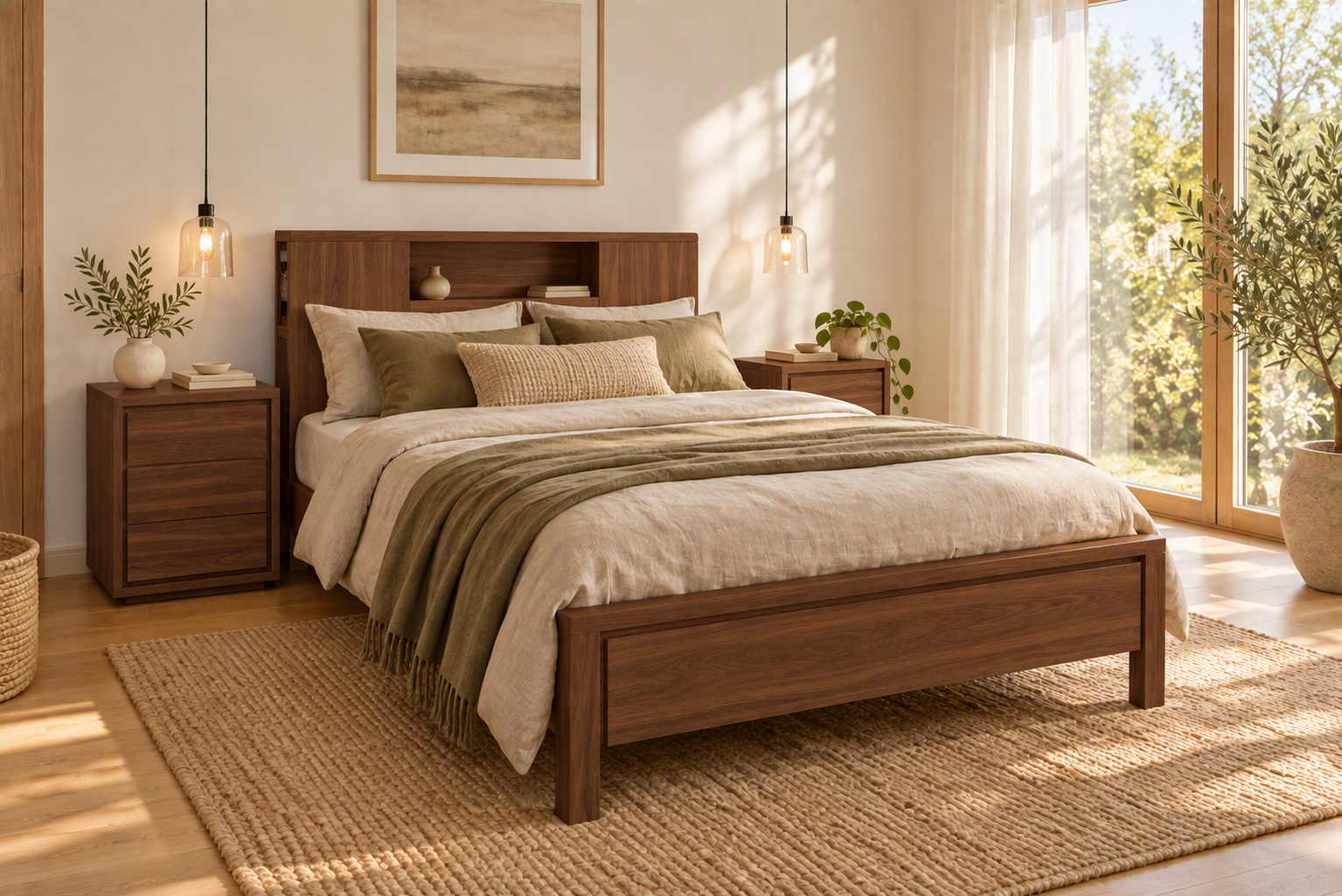
Saturday morning in a furniture showroom, and a couple is standing between two beds. She is eyeing the king. He is pointing out, reasonably, that the room at home is not enormous. This conversation happens in our store almost every weekend, and it rarely ends quickly.
The queen bed v king bed question is really a question about what you are willing to trade. The king gives you more room to sleep. It also costs you floor space, bedding money and flexibility. Put concretely, the trade is this.
The two sizes in plain numbers
| Bed size | Width | Length | Width per sleeper (couple) |
| Queen | 153 cm | 203 cm | 76 cm |
| King | 183 cm | 203 cm | 91 cm |
In Australian sizes, the king is 30 centimetres wider than the queen and the same length. Those 30 centimetres are the entire argument. Split down the middle, a queen gives each partner about 76 centimetres, and a king gives each about 91. That is the difference between being able to roll over without checking first and not.
Who really benefits from the extra width
The honest answer is that some couples benefit enormously and others barely notice. If one of you goes to bed late or wakes early, the extra width means the late arrival can slip in without the whole mattress rocking. If a child or a dog joins the bed on a regular basis, the king is not a luxury, it is crowd control. Tall people, larger people and anyone who sleeps with arms spread wide will feel the difference every single night.
If both of you sleep still, on your own side, in the same schedule, the queen already gives you more than enough room. The upgrade would be nice to have, and that is not the same as worth having.
Think about the next ten years, not just tonight. Couples gain space for a pregnancy, a child who wanders in at 3 a.m., a dog that expands like a bread roll, or a partner who recovers from surgery and needs room to stretch. Life events make a king feel like a wise purchase, not an indulgence.
The space price you pay
The king charges rent in floor space. A comfortable king bedroom needs to be roughly 3.6 metres wide, plus clearance around the bed, and a frame makes the footprint bigger still. Our Madison king frame runs 194 centimetres wide, for example, and the bed itself is over 2 metres long. Measure the actual frame against the room before you fall in love with the idea.
There is also the moving problem. King mattresses and frames are heavy, awkward to carry through doorways and up stairs, and more expensive to deliver, especially in older homes with narrow corridors. If you plan to move in the next few years, that is part of the price too.
The height is part of the footprint as well. A king bed plus a tall frame creates a solid wall of furniture, so measure the visual mass as well as the centimetres. In a room with low ceilings, a king with a tall headboard can make the space feel smaller than it is, while a lower profile keeps the room airy.
Bedding, budget and hidden costs
King bedding costs more across the board. Sheets, duvets, mattress protectors and toppers are all priced by size, and the king premium adds up, with fewer bargain options in the shops. The frame and mattress cost more upfront, and the list of rooms the bed will fit in the future gets shorter.
None of this makes the king a bad buy. It just means the upgrade should be a deliberate purchase, not a default one.
One more cost that surprises people: accessories. A king frame rarely comes with a king mattress in the same package, and the protector, topper and spare duvet all carry the size premium. A queen buyer saves on every one of those items, year after year. If you are on a tight budget, the queen lets you spend the difference on better quality elsewhere, which often improves the sleep more than the extra width does.
A ten minute way to decide
Measure the room and tape out the king’s full footprint on the floor, including the frame. Walk around it, open the wardrobe, pull out a drawer. If you cannot get 60 centimetres of clear floor on at least two sides, the king will make the room feel like a car park with a bed in it.
If the room passes, ask the second question: will the extra width be used? Couples who share sleep space, host children or pets, or simply want their own zone find the king worth every centimetre. Couples who sleep like logs find they have paid for space they never touch. Both answers are respectable, and the right one depends entirely on your room and your sleep, not on what looks grand in a showroom.
If you are still torn, take the test one step further and borrow the decision for a night. Some retailers offer trial periods on frames or can point you to a guest room experience, and a single night on a king is worth more than an hour of showroom debate. Short of that, lie down on both in the store, stretch out fully, and ask yourself honestly where your body settles.
Oak Furniture Collection‘s range puts queens and kings side by side in the same timber, like the Windham and Madison, precisely because the answer is personal. The queen is the safe, sensible choice. The king is the generous one. Measure first, then decide, and if you want a second opinion on sizes, the Sleep Foundation (sleepfoundation.org) covers bed dimensions in detail, and Snooze (snooze.com.au) lists the standard Australian measurements.
